The Historian in the Garden
  • Home
  • About
  • C.V.
  • Contact

Work Smart: Comprehensive Advice for Grads (or Anyone!)

9/28/2016

 
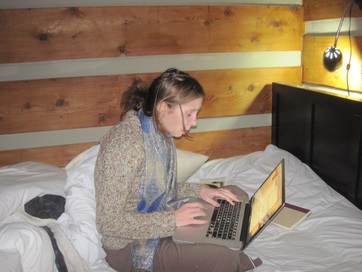
PictureYeah, I'm not allowed to work in bed like this anymore. (Usually I didn't even bother to get out of PJs)
Recently, I had the opportunity to organize and throw the exact workshop that I wish I could have attended during the first month of my first year of grad school. 

When I arrived at grad school, I had no coherent note system besides home-made binders of one-side-printed paper foraged from recycling bins on campus, with recycled cereal boxes (also foraged) to use as dividers. I didn't have any particular work ethic besides "read what looks interesting to me" because I only took classes that were absolutely fascinating and had professors that worked hard to make even the dull points seem intriguing. I had an intense social network of friends who also valued schoolwork, so there was always quiet peer pressure to get work done (even if only so we could party hard later!).

All this changed when I moved to Delaware. I felt really, truly, alone, with more work to complete and information to process than I had ever been tasked with before. I spent the first two months reading every word of every book assigned until I finally couldn't and collapsed from exhaustion and lack of sleep. I want this experience for no one. 

Once the first Professor opened my eyes to bibliographic software, once I was first told I shouldn't be getting bogged down in every word of every book, once the first upper-year grad student confided in me that there were better, smarter, systems of getting work done, life improved by 1000%, as did my productivity and comprehension. With each new phase of my career in history, I've had to adapt again, growing new skills, strategies, and tools for reaching my goals. The time has come to pass on my tiny pile of accumulated advice and knowledge to all who may need it, as I once did.

Nota Bene: This blog post represents nothing original to me; I have groveled at the feet of many wise mentors and confided in many sage peers, who together have built this archive of productivity-making-strategies. Thanks to all of you.

How to Read A Book

Yes, you can make it to graduate level studies in the humanities and not know how to read a book. I know I did! I knew how to move my eyes from right to left, from top to bottom, make sense of the words, take some notes, and even come up with some analytical thoughts, questions, or critiques. But I didn't really know how to most effectively and critically read a book for academic purposes. You need to talk to your mentors, peers, and others in your department and discipline about best practices for you. I will simply pass on my primary introduction, which shaped my reading from then on: How to Read A Book by Susan Strasser. (Go to Section 2/page 3.)

Citation and Note-taking Software 

I use Zotero, made by historians, for historians, for free. I love it dearly and it is one of my gods. That said, people use a lot of other tools. You should talk to people in your department, discipline, and library, as well as watch demos online to figure out what is right for you (and your budget; some will require purchase of software, and some might require a subscription fee). Other popular options used by peers of mine include: EndNote, EverNote, Mendeley, and RefWorks.
  • ASIDE: The marvelous instructor and brilliant scholar David Suisman is to thank for introducing me to Zotero; thanks to him also for presenting in last week's workshop and always having a moment to lend advice to the grad community.

There is another set of closely-related programs that can also be used for note-taking, but prove their real worth when helping you write and make new material out of the source material you've assembled. Some people use one software from the above category for all their needs and Word for writing (like myself), some people use software from this second category exclusively, and some people use a citation software from above and one of the writing softwares listed here (I am thinking about making this transition.) In this category are: Scrivener,  Idea-Mapping softwares (link to an inventory of several in this category), LibreOffice, and FocusWriter.

Setting Goals, Scheduling Tasks

"Things that get scheduled get done."
While I have settled on old-fashioned pen-and-paper to-do lists (preferably held within a Slingshot Organizer), there are many ways to skin this most-crucial-of-all-cats. You NEED to know what you have to do, in order to do it. I've heard personal testimonials about other list-making-systems including:
  • Bullet Journals  -- Deceptively, this is a method, not a product. It helps you organize, prioritize, and visualize. You buy into it or you don't. By the time I discovered this, I had developed a very informal system of symbols for accomplishing the same, but if you have no system, check it out.
  • Productivity Journal -- Is prioritizing your main problem? Do you know exactly what needs to get done, but find yourself cleaning the kitchen, doing the laundry, or even working on academic side-projects instead? Then this is for you. While it is a product, you can also just photo-copy your version of the template onto a notebook of your own making (with materials scavenged from one-sided printed paper in library recycling bins, right?!?!)
  • ​Sticker charts -- My friend and fellow-scholar Darcy Mullen is all about the stickers, and that is AOK. If you just have problems with motivation alone, invest in some awesome stickers and shamelessly reward yourself for your productivity-achievements by affixing them one by one to a chart or location of your choosing. 
If digital organization is more your thing, here are a variety of apps and online options for you to organize your life:
  • Habitbull -- This app is fantastic for visualizing your progress toward completing your goals. Build habits one day, one week, one month at a time, with myriad options for customization, color-coding, and adjusting your goals to suit your schedule. If you thrive off 'streaks,' this may be for you.
  • Trello -- Taco, the canine mascot of Trello, is your guide to the best to-do list application that may be out there. You can have multiple to-do lists for different segments of your life, share to-do lists with group or team members for collaborative projects, and instead of disappearing when a task is done, you get to shift items over to a DONE list that you see grow before your eyes! So rewarding!
  • Workflowy -- If multiple to-do lists and all the complexity of Trello is overwhelming for you instead of relieving, Workflowy has a beautifully simple, straightforward aesthetic and functionality to help you compile (and complete!) your to-do lists. 

Actually, Really, Getting Stuff Done

So you have the software and notes ready, you know what you have to do . . .  and sometimes the writing and working still doesn't happen. (If this isn't true for you, keep it to yourself and be frickin' grateful, please). I've discovered first and foremost that I am a socially-motivated, socially-oriented creature. I deliver best on things when I run the risk of disappointing people if I don't come through, and impressing people when I do well. Peer pressure has almost always served as positive force in my life, thanks in no small part to the excellent people I have been able to surround myself with. So here is my working tool-kit:
  • Pomodoro Writing-Dates -- I'm writing this as part of one right now! (A warm-up before launching into dissertation writing, something I've discovered helps me.) Pomodoros are a method of working where you set a timer for 25 minutes; at the end of this work sprint, you have a five minute timed break before the next cycle starts again. After four 25-minute work sessions, you have earned a 15 minute break. I make this work for me by connecting with writing peers through online messaging. Every week at the same time and day, my partner(s) and I start the timer at the same time and go. On the breaks we discuss what we accomplished, check in on each other's personal lives, work through any tricky ideas or exciting finds, and/or set goals for the next segment, and repeat. If you use the marinaratimer.com program that I linked to, by sharing the link with your partner, your timer is the same. Another perk of marinaratimer is that you can customize your work-break patterns to find what fits best for you.
  • Write-on-Sites -- Sometimes even better than cyber-writing is group writing in person. The write-on-sites I've attended and organized tend to work on similar principles as Pomodoros, but use a half-hour of work with ten minutes of break, if only because there are more of us to go around in the circle when we share our goals for the next work session, and more brains to pick when you need advice. I try and seat myself so that my screen is potentially visible to other people, because then I have another subtle motivation to stay off the internet, and just keep typing. [If you are in Newark DE, and I the other Grad Student Representatives have organized formal Write-on-Sites at 77 E Main from 9AM-12PM on Wednesdays and Thursdays, in the front room or back conference room if we have enough people]
  • Daily Writing -- I have become convinced that this is absolutely imperative. No weekdays off from working on, touching, interacting with, and doing minimum of typing on the dissertation. Have I accomplished this goal as an actual yet? No, but I'm working on it! Already just striving toward this, simply not being ok with taking a day off to just read is helping me tremendously. 
  • An Internet Blocker when necessary -- but it often is. When I'm working at home without any peer support, this can be crucial. I use Self-Control, which works great and is absolutely, 110% un-reversable once you start it going, even if you reboot your computer, quit and uninstall the app, anything. What I like is that you can operate on two settings: either a black list (list of sites you cannot visit) or a white list (a list of the only domains you can visit). This allows me the freedom of accessing online articles and research while still blocking all the most pernicious rabbit-holes of research and recreation the internet allows.
My way is not the only way however. In talking to peers, mentors, and other academics, I've uncovered a whole host of other ways people work -- some of which I am considering or trying to add to my arsenal, and others of which are not for me. Here are some of those practices I don't use right now, with the reasons people have told me they like them:
  • Other forms of academic peer pressure -- when I hosted this workshop, people shared motivation tools ranging from snap-chatting peers photos of empty library desks to pressure them to get out of bed and to work, to weekly skype dates with a long-term work buddy, where you set and check in about weekly goals for your professional lives and projects. 
  • Figure out your daily 'best work times' and schedule your most important work for those slots. I find my schedule subject to too many things out of my control to rely on this method. My husband works sometimes irregular hours at the hospital, events and life stuff happen. . . . and I'm pretty bad at noticing patterns like this. For now I'm trying to figure out how to work at any time, even if it doesn't feel particularly 'natural'.
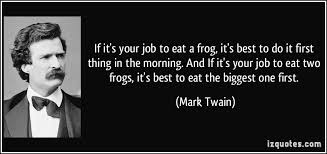
  • Write First Thing -- Some people in particular emphasis 'free-writing' first thing in the morning to just get your thoughts out for a minimum of fifteen minutes. Some people say shoot for a minimum of a half hour. Some people say just do all your writing for the day then, even if that means two hours. Have an 8AM meeting? Then get up earlier! My sage (and productive) friend Michelle Anderson often invokes Mark Twain to explain this philosophy:
Picture
#eatthefrog
  • Decide What's Next -- Your last task of the day should be to decide exactly what comes next tomorrow, so that you can pick up your writing and research with momentum. What question are you reading this book to answer? What's the next thought you want to articulate? My esteemed colleague Elizabeth Jones-Minsinger passed on advice once given to her: always stop writing in the middle of a sentence. Then, your brain will be working on how to finish it until you return, and you'll both have spent really productive off-time away from it, and be ready to attack it again.
  • Go Analog -- many of my peers testify that writing by hand with pen and paper, can be an excellent way to work through ideas or make it through some tough writers block, especially if your primary mode of writing is digital. The physical motions, the different speed of writing, prompt a different way of thinking, they claim. I haven't hit any particularly heinous rough spots lately, but I'll be trying this the next time I do. 
  • Go Nuclear -- I have not tried this, and do not think I will unless I am truly desperate. However, if you really need to make yourself put words one after another, the brilliant Jeff Applehans claims that the website writeordie.com has helped him in the past. The concept is simple: set a timer, and a goal number of words, then go. If you fail to keep pace, the program will start making angry noises, turning the screen red, and even deleting the vowels from the early parts of your writing to keep you going. HARSH.
  • Outsource Critiques -- A very wise practice that I hope I can force myself to implement. UD is lucky enough to have Dr. Steve Marti as a PostDoctoral fellow in the history department at the moment. When asked about his work ethic, he concedes that he doesn't actually have much problem sitting down and writing (damn him!), but that he has trouble knowing when to stop working on something. He suggests circulating your work among trusted peers throughout the writing process, and confining your revisions as much as possible to the problems they identify. That way, your list of things to work on it finite, as opposed to the infinite revisions we would all make to our own work if left staring at it by ourselves.

Other Resources

  • I cannot recommend highly enough signing up with the National Faculty Center for Diversity and Development. Hopefully, your workplace has an institutional membership you can piggy-back off of. Their weekly "Monday Motivators" help keep me on track toward reaching my goals and aiming to improve my work practices. They also offer boot-camps, webinars, forums, and many other resources.
  • Writing Your Dissertation in Fifteen Minutes a Day by Joan Bolker. Read it. It IS a worthwhile investment of your precious time.
  • Look to your discipline for resources, support, and tools. If you are an historian, the AHA has a fantastic set of Resources for Grad Students.

Final Thoughts -- before I get back to my dissertation

If there is anything I've learned in this process, it's that contrary to the philosophy of Fredeerick Winslow Taylor, there is no "one best way" to scientifically manage your way to success. I have a broad toolkit because some tools work some days, and some on others. Start collecting your own set of tools. Make checking in with your work practices an important part of your self-care routines (which you should totally have, and should include exercise!). 

​Be well, and WORK!

Environmental History Grad Writing Workshop - Join us!

9/26/2016


Call for Papers: ASEH 2017 Writing Workshop

Picture
The Graduate Caucus is pleased to announce its call for participants for the 5th annual Graduate Student Writing Workshop to be held at the ASEH annual meeting in Chicago in 2017. Selected writers will join in small discussion groups with other graduate students and a faculty mentor to workshop pre-circulated pieces of writing. These small working groups will be organized by type of material - thesis/dissertation proposals; conference papers; journal articles (including Gallery submissions); and thesis/dissertation chapters. Please note that a 15-20 maximum page limit will be enforced. Applicants are invited to present their most current work.


The purpose of the Graduate Student Writing Workshop is to provide a forum for graduate students in environmental history to develop their writing and research skills. Guided by the faculty reader, each participant will read and comment on the work of fellow participants. The workshop will emphasize all aspects of the writing process, from cultivating the first germ of a project, to chapter organization and revision, to shaping proposals and abstracts. Groups will be encouraged to discuss writing style, voice, and mechanics, as well as practice how to get and give good feedback. Confirmed faculty participants include Andrew Case, Finis Dunaway, Catherine Dunlop, Stephen Pyne, and Kendra Smith-Howard.


To apply, submit a one-page (double-spaced) summary of the work that you intend to bring to the writing workshop. Note in your application the subject matter of your work as well as the format and potential audience. In addition to the one-page summary, include a one-paragraph bio indicating your research agenda, educational affiliation, and current contact information. Applications should be sent via email to Anastasia Day ([email protected]). The deadline for applications is December 1, 2016. Please note that, if accepted, the final version of your work must be submitted to your faculty reader and fellow participants no later than February 27, 2017.

Picture

Weekend Reading . . .

9/14/2016

 
Picture
If you haven't already, you should definitely be checking this out: The Graduate Association of Food Studies has come out with their Fall 2016 journal issue! The contents are amazing, written by intelligent and enthusiastic up-and-coming scholars across many fields and disciplines who study food. I was lucky enough to have joined onto this exciting organization close to its inception; through it, I’ve met some truly incredible individuals who inspire and inform my work. If you work in anything related to food, I cannot more highly recommend joining this supportive community by becoming a formal member. 
Visit https://gradfoodstudies.org for the whole issue!

Picture

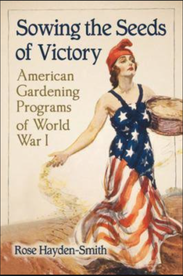
Selfishly, this issue is extra exciting because it’s a new opportunity to see my name in print, and my writing in publication. Even more exciting, I was able to help promote a thoughtful book that I found intellectually stimulating, historically well-researched, and extremely relevant to food conversations in twenty-first century America. In short, I authored a review of Rose Hayden-Smith’s Sowing the Seeds of Victory: American Gardening Programs of World War I (Jefferson, NC: McFarland & Co., 2014). Read it yourself here: Review of Hayden-Smith, Sowing the Seeds of Victory.

Just coincidentally, as I was looking for the cover-image of the book for this blogpost, I saw that around the same time I was first submitting my review to GAFS, my colleague Chris Deutch also reviewed it, on H-Net (cross-posted on H-Environment and H-War). Read his review here. We largely concur -- how validating!

Less selfishly again, you should definitely be sure to read my esteemed peer Darcy Mullen's article entitled, "Cartographic Communities of Locavores: Local Ideographs & Spatial Rhetoric". She takes a compelling look at what local food movements *mean* today -- and I mean that in the semantic, rhetorical, ideological senses; what does 'local' denote and connote? How can ideographic theory help bring clarity to such socio-spatial rhetoric?  
To read more of her work in her blog on food, and books about food, check out http://storiesofsoil.blogspot.com.​
Picture
Image from Mullen's article. You know you want to read this.

Autistic Students Fail Because of Institutions, Not Professors

9/13/2016


Nota Bene:

This is a personal issue for me, absolutely. On the one hand, I am aiming to enter the ranks of the professoriate, and care deeply about both pedagogy and the plight of university teaching staff  in a professional capacity. On the other hand, I have the deeply personal experience of being older sister to a wonderful, amazing, talented young man who is on the spectrum. He has received his Associates degree from a local branch of a state college. However, it is clear to everyone who has ever met him -- or heard his highly technical music, which has made its way onto two internationally syndicated television shows! -- that he is fully capable of the intellectual task of completing a bachelor's degree. One of my parents has also been deeply involved in multiple aspects of higher education (though never as professor, working closely with professors) at two different institutions. To this, I also add my own years at Lawrence University and then the University of Delaware. It is this body of experience and evidence that informs my thoughts here.

Reflecting on Inside Higher Ed's article, "Students on the Spectrum"

This morning, I woke up and read my daily digest of InsideHigherEd articles, to help me keep abreast of national events shaping academia. I don't always agree with the opinion pieces, but I read them anyway; of course I clicked through an article about autism and post-secondary education. The authors, Elizabeth Finnegan and Margaret Finnegan, open with some troubling and undoubtedly true statistics, and come to a sound conclusion based on them:
A 2015 Autism Speaks report found that only 30 percent of high school graduates with autism ever attend a two- or four-year college, and those that do fare poorly. Research suggests that 80 percent of them never graduate. Furthermore, only 32 percent of high school graduates with autism find paying work within two years of graduating high school. This need not be. Half of all individuals with autism have average or above-average intelligence. They can do the work. The problem is not the students. It’s the colleges. [....] Together, we have seen the many ways that colleges fail students with autism.
My fist was raised in the air! Yes!
​We are talking about making Higher Ed more accessible, not for those who cannot do the work or maintain the intellectual standards of the institution, but for those who ​can and are not given the institutional support to do so. The authors went on to make another slam-dunk point:"if autism is indeed a social disability, then denying the social needs of autistic students is inherently unreasonable". Carry on with the structural critique, I cried! Lay it on me, and I will broadcast your message from the rooftops! 

As the article went on though, something went deeply wrong. Perhaps you can spot a trend:
When students felt their social needs were met -- in particular when faculty members proved willing to modify their teaching style -- students had much more positive experiences. But American professors are not required to modify their teaching style for disabled students
[....]
It would help if faculty members understood how autism affects learning. But professors are busy [...] professional development seminars are often poorly attended, especially those focused on helping students with special needs. [...]Even when given the opportunity to learn more about the needs of disabled students, professors turn those choices down.


​What happened to institutional critique? Then again, why delve deep into causes of underfunding, problems of administrative support, societal stigma around neurodiverse individuals, or what is making the professors so very busy, when you can simply lay the lion's share of the blame and responsibility at the professors' feet???

​Don't worry: professors can present work, research in archives around the world, publish books, articles and materials meant for public audiences, mentor higher-level students, teach introductory classes AND spend significant amount time finely honing pedagogical skills! [/s]

All these things are not possible at once. Furthermore, from a shallow political perspective, dumping on faculty like this is just justification for more budget cuts. What we need -- and will not get by simply denigrating university teaching staff-- is reform and justice in the academic labor market. This would actually help faculty to help students.

To Be Fair...

I also know that terrible professors can be a big portion of the problem and definitely exist. The article details the experience of one its authors interacting with a faculty member: 
Elizabeth, for example, struggles with understanding if professors are being sarcastic or rhetorical. Uncertain, she often responds too much or too little. When one professor expressed frustration at her eager hand raising, she asked privately if he would signal her when he wasn’t being serious or didn’t require a response. “No,” he said. “I don’t need to change my teaching for you, and you need to learn sarcasm.”
 You cannot just ask someone on the spectrum to 'learn sarcasm' on top of your course load; this is truly atrocious! Yet,I believe this story whole-heartedly. I've heard stories of the same and worse levels of appalling callousness; I have seen them unfold. In some cases, the adjuncts have given up on ever getting tenure, never were trained to teach during their masters or doctoral degrees, and/or don’t get paid enough to care between their commutes and second (and third and fourth) jobs. The tenured professors just don’t have to care and/or are bitter over being stuck at a community college instead of an R1; some should have retired years ago. Some of the tenured professors who aimed for R1 also never learned how to teach, spending all their time on research. I'm not saying all university instructors are infallible, above critique, or even good at teaching. But do these anecdotes represent a majority, or even a statistically significant percentage of professors??

Furthermore, I also hold pedagogy important. Yes, I feel personal responsibility for the well-being of students within my classroom, and have made a point of personally seeking out all the tools available to me to make myself a better, more inclusive and welcoming instructor. I would be one of the three faculty attending those workshops on dealing with disabilities in the classroom; UD offered an excellent opportunity to do so just last year,


Why do I disagree so vehemently then, if I agree that faculty can be major causes of failure for autistic children -- and yes, also major parts of the solution???

​Because this article stops at blaming professors.

What if I told you the reason I couldn't attend the disabilities in the classroom workshop last academic year was because I was trying to grade 87 mid-term exams in a single weekend, while also finishing another draft of my dissertation prospectus?

The problem is the university teaching labor system, and this article doesn’t address or even acknowledge the underlying causes at play, of which overworked and under-dedicated university instructors are often mere symptoms.  How about the fact that 70% of university teaching staff across the United States today fall under the classification of non-tenure-track-faculty??? The vast majority of those are adjuncts; they are underpaid and overworked. Many are not even offered offices, let alone professional development opportunities. And how can they attend these unpaid 'opportunities' when over a quarter rely on food stamps to make ends meet, and many more still fall below minimum wage in their annual earnings.  There are myriad articles detailing the crisis of labor in higher education, and how this issue lies at the very heart of the corporatization of the university, budget crises, disappointing student learning outcomes, and more. Educate yo'self!
But at least not all the responsibility for fixing the problem falls on faculty; the authors move away from faculty alone when they talk about solutions. They point out just how helpful social support from other students can be, and how meaningful:
For Elizabeth, the greatest support has often come from students who have chosen to act as social interpreters. A whispered word or two is often all she needs to better and more appropriately engage with her curriculum. Colleges like California State University at Fullerton already have mentorship programs that pair neurotypical and neuroatypical classmates. We recommend expanding such programs so that peer mentors -- perhaps those offered the coveted privilege of priority registration -- work side by side with autistic students in the classroom.
I agree; such programs are wonderful, and peer support can be fantastic. However, this also side-steps the fact that universities are broken in their very bones. The whole problem cannot lie with university instructors, and the whole solution cannot be instructors teamed with student aids. The worst thing we can do for all students - neurotypical and neurodiverse alike -  is to shallowly malign instructors for systemic problems of which their pedagogies are effects, not causes. This article is yet another that side-steps the deep ​​crises of higher ed to focus on bad-mouthing professors, the face of the university, and offer glib, no-reform-needed solutions. But faculty and students alike deserve better. We deserve more. We need to demand more from our institutions to serve the needs of all. 

A Summer at Hagley: Archives, Authors, and Allergies

9/7/2016


A Recap of My 'Day Job'

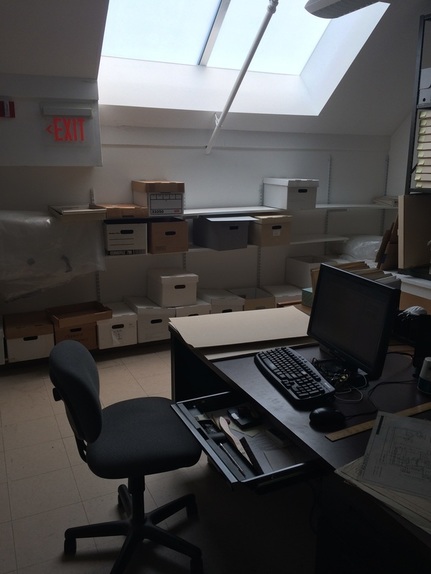
PictureHow many archives gigs include a desk with a skylight?! Lucky indeed.
​
​           This summer, I was lucky enough to obtain an internship working in the Manuscript and Archives Department of the Hagley Museum and Library; I needed to find something local, convenient, flexible, and paid, given my obligations to my garden, my dissertation, and my wedding! I was beyond fortunate to work with the delightful staff in the gorgeous Soda House, taking materials from their original boxes as given by the donors, organizing the materials so they are easy for future researchers to access, and rehousing in new folders. I would deaccession duplicates, select materials in need of conservation, and set aside photographs, VHS’s and other materials more appropriate for the Audio-Visual Department to handle. While I had amazing supervisors, support, and guidance, I was given autonomy almost like any other employee. The result was a summer of growth, exploration, skills acquisition, and a surprising love affair with seeing archives from the other side of the reference desk.

Abbreviated List of Materials I Processed (That Researchers Should Know of!)

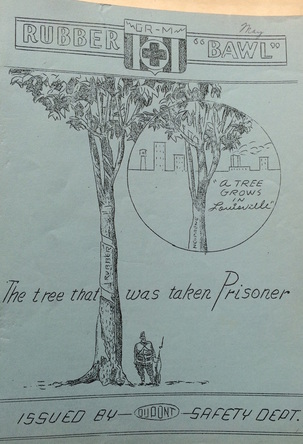
Picture*The Rubber Bawl,* May 1944. Dupont Louisville Works Safety Department. Dupont Performance Elastomers LLC, Collection.
  • Dupont Performance Elastomers LLC, Collection The bulk of this collection is an incredible run of employee news publications from 1943 until 1991 at the Dupont Neoprene plant in Louisville, Kentucky. It was a joy for me to find myself doing accidental research on factory conditions in World War II, as well as to see the evolution of employee culture, interests, and recreations over the years.
  • Edy Mozzi Papers - When I was cataloging this, I treated it as its own collection with its own accession number. Since I departed, it has been transformed into Series IV of RCA Camden records. This makes much sense in terms of contents, but my finding aid research was much abbreviated: if you are interested in reading my expanded finding aid information for this series, contact me.
  • ​Electrical Power Systems Records - These records were donated to Hagley by Dr. Julie Cohn; some of them came from her father’s work and career. They also formed a small portion of the research that went into her dissertation, soon to be book manuscript: "Biography of a Technology, North America's Power Grid Through the Twentieth Century". (University of Houston, 2013) As that title might suggest, these papers are those of engineers – primarily former Leeds & Northrup Co. employees – who were involved in the technological problems of connecting power grids across the United States in the 1900s.

  • James W. Scarlett Letters - These papers were kindly sent our way by James’ son,  Dr. Timothy Scarlett, a professor at Michigan Technological University’s Industrial Archaeology program. Dr. Scarlett was primarily responsible for organizing, writing up historical/biographical context, and creating an inventory of the materials.
  • Marconi Wireless Telegraph Company of America Engineering Drawings - I wrote a blog post trying to spark public interest in the materials for the Hagley Sarnoff Project blog entitled: "The Titanic Connection." Read there for more about these incredible artifacts.
  • ​William G. Ramsay Family Correspondence - Really interesting set of letters, bulk 1868-1916 from a figure that Hagley already has materials pertaining to. This collection is most interesting for the correspondence to and from female family members of William. Personal favorites included William’s letters to his wife -- and hers to him:
My Dear Heart Willie -
Did you know I did not realize that you were going today to be away till Thursday -- I felt quite pitiful about it for I really did not say Good-Bye at all --at--all-- I have written five letters this evening ...
[William G. Ramsay Family Correspondence, Box 1, Folder 2. Lena to William (18 letters), 1893-1903]
Picture
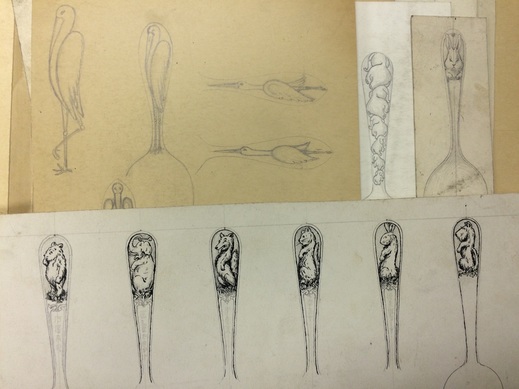
At the very end of my tenure, I assisted Marsha Mills with Lunt Silversmiths Records, accession number 2544. Stay tuned for a full finding aid later this fall, but accept this sneak peek of some children's silver spoon designs!

Take-Aways from My Summer Loft

PictureSoda House gussied up for a wedding.
          Archives are FULL of dust and mold that will trigger all your morning summer allergies. Blueprints and simply dirty materials will stain your hands black with dirt if you don’t wash frequently, and sometimes leave an icky residue anyway. Oversized materials can necessitate standing on your feet all day carefully moving huge and delicate sheaves of paper from one table to another. Boxes of paper quickly become very heavy indeed, and moving boxes from shelf to shelf can be a workout in itself, even if you have indeed been doing the occasional pushup in the mornings, as I was. The stacks are freezing to protect the books, and you can feel very silly packing huge, heavy cardigans for work during an excessive heat warning. But to be honest, the worst part about working at Hagley all summer was seeing other people working on the Charles Lamb design collection or original Hagley building blueprints and wishing I could ALSO be helping with those!

          Indeed, for all the back-ache and sneezing, I took great joy in my work this summer. I discovered an unexpected form of intellectual stimulation; the puzzle of looking at raw materials, figuring out what they are, and trying to see all or many possible angles for research within them – not just approaching with my own lenses of food, environment, social history. These materials could all be used for so many different projects, and help to answer so many different questions. While it wasn’t my job to think of them all, it was my job to organize the materials so they could be most easily used for the widest variety of purposes – and easily accessed by researchers from out of town on pressing time-tables. I think I’ll have a lot more empathy going forward whenever I get frustrated with a finding-aid, outraged by a filing scheme, or can’t find what I need in the first half hour within arriving at a new archive. Thanks for all you do, archivists – especially my amazing co-workers from this summer: Lynn Catanese, Lucas Clawson, Clayton Ruminiski, Chris Baer, and Marsha Mills. 

ADDENDUM - MORE HAGLEY

Want to spend more time at Hagley or see what researchers there are up to? Check out any of the following:
  • Stories From the Stacks - researchers on the property talking about their work in audio form!
  • CONFERENCE - MAKING MODERN DISABILITY: HISTORIES OF DISABILITY, DESIGN, AND TECHNOLOGY October 28.
  • Author Talks - hosted in the Soda House, featuring new books based on Hagley archival holdings
  • Research Seminars - scholars present works-in-progress, pre-circulated with RSVP, for comment and discussion.

The Historian in the Garden - An Explanation.

5/5/2016

 
'The Historian in the Garden' might seem a simple, self-evident title for this blog-venture -- and hopefully it is! I garden, I go out into my garden frequently, and I am a historian. I even occasionally write outside near my garden! However, I also chose it with a few other layers of meaning packed in, like I'd like to unpack here.

The Book

Picture
The book title I am playfully riffing on is that of Leo Marx's 1964 masterpiece, The Machine in the Garden: Technology and the Pastoral Ideal in America. [Pagination is from my copy, New York: Oxford University Press, 2000.] 

Leo Marx was an early scholar in American studies -- working from the basis of U.S. exceptionalism and looking to explain unique traits of the American experience and national character. This book was based on his 1950 dissertation in the History of American Civilization, completed at Harvard.

His source base is limited primarily to the literature produced by 'great' (read: white, male) authors of the American cannon. Washington Irving's Sleepy Hollow, The Tempest ('Shakespeare's American Fable'), the agrarian writings of Thomas Jefferson, the technological visions of Tench Cox, and bits of Emerson, Thoreau, Twain, Hawthorne, Melville, and many more appear.

Through these disparate authors, Marx identifies a unique and persistent trope: these authors, in grappling with the onset of American industrial power, locate a tension between nature and culture in the form of, well, a machine in the garden. In his own words:

[Throughout the American cannon,] the machine is made to appear with startling suddenness. [...] The ominous sounds of of machines, like the sound of the steamboat bearing down on the raft or of the train breaking in on the idyll at Walden, reverberate endlessly in our literature. (15-16) 
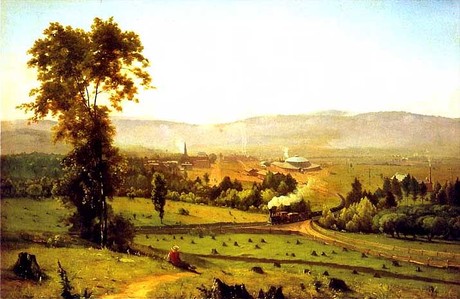
It is the intrusiveness of the new technology that is key for Marx. The most common machine intruding throughout American literature is a train -- hence the book cover image above. The train has long been recognized in its time and our own for breaking down and reorganizing traditional ideas about space and time. The train network is often famously credited with creating standardized time; Backstory Radio has an excellent podcast covering the completion of the trans-continental railroad as the first time Americans tried to experience an event simultaneously. While we thus often eulogize train network expansion as a unifying force in American history, Marx points out that such technological networks broke down old distinctions that helped us make sense of the world--especially the line between the city and the county.
​The distinctive attribute of the new order is its technological power, a power that does not remain confined to the traditional boundaries of the city. It is the centrifugal force that threatens to break down, one and for all, the conventional contrast between these two styles of life [pastoral and urban]. (32)
Picture
George Inness, 'Lackawanna Valley,' 1856, National Gallery of Art.
Marx ultimately concludes that the intrusion of the machine into the garden exposes the inadequacies of our traditional imagery to understand the modern American relationship between nature and culture. Why are American literary heroes always left broken by the intrusion of the machine in the garden? Is there truly a pastoral paradise left to intrude upon? Or has the train been there as long as we have?
These works manage to qualify, or call into question, or bring irony to bear against the illusion of peace and harmony in a green pasture. (25)  [...] To change the situation we require new symbols of possibility, and although the creation of those symbols is in some measure the responsibility of the artists, it is in greater measure the responsibility of society. (365)

The Garden

As I write my dissertation, I am working to figure out a few basic questions: what IS a garden? How can we define it? My brilliant advisor asked me this very question during my doctoral oral exams, and then as well as later, I have come to a list of ways that you cannot define a garden:
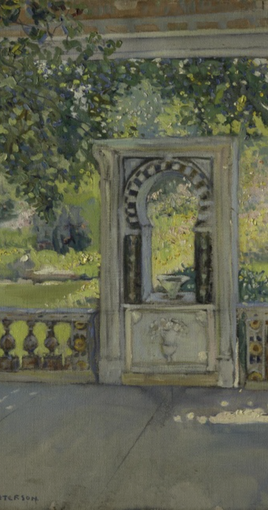
PictureDetail, Jane Peterson, 'Turkish Fountain with Garden,' ca. 1910, Metropolitan Museum of Art
  • Location -- It is tempting to state that a garden constitutes plants that are grown at or near the home, while agriculture is out in fields. How then, however, to explain public gardens? Botanical gardens? Community gardens? While certainly gardening and domesticity are entwined in certain times and places of American history, the connection is not definitive.
  • Function -- Gardens can be healing, as seen in the growing gardens for veterans movement, hospital gardens, and the growing field of horticultural therapy. Gardens can also be aesthetic and artistic places, as the American Impressionist painters conveyed in oils -- see The Pennsylvania Academy of Fine Arts online exhibit, The Artists' Garden.  Gardens can be public and educational, as the mission statement of the famed St. Louis Botanical Garden illustrates. Or they can be privately cultivated in food deserts where that may be the best way to ensure nutritional, fresh, meals for your family; such gardens grow social justice as well as vegetables. Some gardens, like Victory Gardens, are highly political and patriotic. However, there are no strict rules: gardens can serve multiple of these functions or other ones entirely.
  • Relationship to the market -- When thinking specifically about how to differentiate gardens from agriculture, an easy answer might seem to be that agriculture is done for a living, to produce commodities that sell on the market for profit, while gardens remain outside the commercial sphere. However, this doesn't hold either. What about public gardens who charge for admission? Or what about truck/market gardens? How about the ways that gardens play into domestic economy by saving money on food? They may not enter the marketplace, but they are still shaped in relation to it. 
Here is where Marx proves helpful. I assert that the garden is ultimately a construction--not only literary, but also social, cultural, and political. I think the reason I can find no strict definitions of what constitutes a garden, is that the social meaning of gardens and gardening is constantly changing, representing a unfixed middle ground between "wilderness" (whatever that means) and "civilization," nature and culture -- an Arcadia we constantly seek.  In this, I agree with Marx that symbols are important to our political and social self-fashioning. However, while I am thoroughly ready to abandon the trope of the machine in the garden, I remain convinced that the garden remains ever more relevant to the twenty-first century. 

As much as the garden is a construction, it is also, undeniably, a place. Gardens are material and real. They have plants, with roots in the soil and leaves angling for sunlight. One can sit there and think, and write. This summer, that is what I intend to do: a historian in her garden.

Picture

    Author

    Anastasia Day
    History-Phd-in-Progress. Writes about environment, food, people and how the past informs the present.   

    Tweets by @Anastasia_C_Day

    Archives

    July 2020
    June 2020
    April 2020
    September 2019
    July 2019
    September 2018
    August 2018
    June 2018
    May 2018
    April 2018
    February 2018
    January 2018
    September 2017
    July 2017
    May 2017
    March 2017
    February 2017
    January 2017
    November 2016
    October 2016
    September 2016
    August 2016
    May 2016
    April 2016

    Categories

    All
    Academia
    Archives
    Book Reviews
    Current Events
    Environmental History
    Everything Has A History
    Food Studies
    Pedagogy
    Victory Gardens

    RSS Feed

Proudly powered by Weebly