"Only two things money can't buy
That's true love and homegrown tomatoes !"
(Do watch the whole thing; it's 2:30 of pure joy and you will hum it while reading the rest of this post)
If I's to change this life that I lead,
I'd be Johnny tomato seed...
My partner is a tomato fiend—tomatoes of any form, in any dish, anytime is AOK with him. In contrast, I am only tomato-tolerant most of the year when our only options are cardboard red spheres raised in greenhouses or canned red gunk coming from our local chain grocery store. However, all that changes in the summer. The moment I get to grab a sun-warm, crimson globe of juicy sweet flavor off that vine, I’m hooked until the home-grown tomatoes are all gone. Further impetus to our household’s tomato-love was the recent acquisition of a pressure canner as a wedding gift (from my in-laws, who know us very well!). We were determined to have not just some tomatoes, but MANY, MANY tomatoes this summer, and to preserve them to bring some summery warmth to our winters.
Plant 'em in the spring; eat 'em in the summer,
All winter without 'em's a culinary bummer
We planned for a grand total of 25 tomato plants and wound up with 27. Per our garden plan, only 14 of those are in the Victory Garden. We have 9 more off the back porch, two that were in pots and later transplanted out, and accumulated two accidentals. This was a lot of tomatoes. We’ve canned over 100 lbs already and dehydrated probably close to 50 pounds more. We’ve eaten roasted tomato soup, gazpacho of all colors and sorts, mostly-tomato-tabouli, many variations on tomato pasta sauce, burst-tomato galette, stuffed tomatoes (from Moosewood), salsa of so many varieties, fried green tomatoes, and just plain sliced and cubed tomatoes on top of most of our meals at this point.
I know what this country needs:
Homegrown tomatoes in every yard you see!
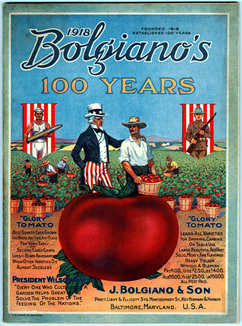 WW1 gardeners grew tomatoes too!
 Just as they are in back-yard gardens today, tomato plants were the indisputable hallmark of Victory Gardening in World War II. Our pre-occupation with tomatoes is only in keeping with my historical experiment, in other words. Every single Victory Garden plan I have come across includes tomatoes, and every instructional guide lists the vegetable among recommended plants for even the most tiny backyard plot. Even if you didn't have a patch of land or a plot, Americans still found ways to grow tomatoes. Victory gardener Elizabeth Guthrie remembered walking down New York City streets and seeing "every window box with a tomato plant in it." [25 Years of Community Gardening. (New York: American Community Gardening Association, 2005).] Tomato recipes exploded across the pages of wartime cookbooks to use up the harvest -- including entries in the 'Desserts' section such as "Tomato Spice Cake" !!! (I have tentative plans to bake this; rest assured, I'll update with results.) Meanwhile, housewives across America canned more tomatoes than I'm sure I could ever fathom.
As a final illustration of the importance of tomatoes in war, please read one of my favorite historical finds EVER, straight from the Wall Street Journal at the height of the war:
As a final illustration of the importance of tomatoes in war, please read one of my favorite historical finds EVER, straight from the Wall Street Journal at the height of the war:
'My one and only,' He cried passionately, 'come to me. Shake off the hackles that are holding you dormant, arise and let me take you in my arms. Let me display you in all your pristine glory to envious friends and passersby. Raise your head to the heavens and your face to mine, and by so doing make me the happiest, proudest, and most fortunate man in all the world. Arise, my love, arise.' |
I forget all about the sweatin' & diggin'
Everytime I go out and pick me a big one
But that's not quite true. I remember a lot of the sweating and digging. I remember the struggles. And, as a historian, I naturally feel it's important to document those struggles filled with sweat so we can improve upon this for next year! Therefore, a list of our problems:
Lack of Variety
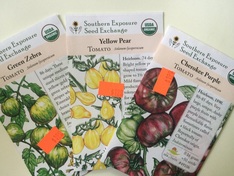 Yay Southern Exposure Seed Exchange!
 We only had three types of tomatoes, none very different from each other. We grew heirloom Brandywine (it only seemed patriotic, living as close to the Brandywine as we do), ‘Big Beef’ varietals that were gifted to us as starts by our amazing landlord, and then Fox cherry tomatoes. All three were slicers, all three were red, round, and of similar size except the cherry tomatoes. Turns out, you can get a little bit sick of home-grown tomatoes.
Solution:
Next year, I’m growing many different types of tomatoes for different purposes! Green Zebras and Purple Cherokees for color, flavor, and novelty, golden pear cherries for our small ones, and then only filling in the gaps with generic slicers like Brandywine and Big Beef.
Solution:
Next year, I’m growing many different types of tomatoes for different purposes! Green Zebras and Purple Cherokees for color, flavor, and novelty, golden pear cherries for our small ones, and then only filling in the gaps with generic slicers like Brandywine and Big Beef.
Lack of Support
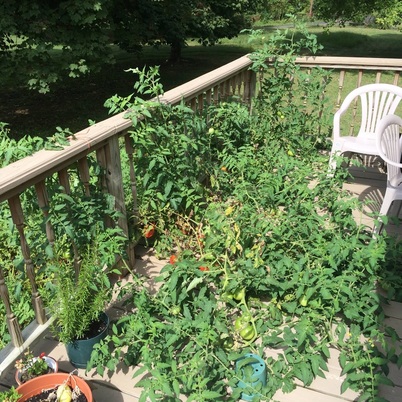
Not, not emotional support; the physical kind that should be easy and straightforward. We inherited some tomato cages this year. I had never used such contraptions before, but they appeared to be period-appropriate (can I get a source on this???), popular and low-effort to set up; plop it on and call it a season, right? No. Seeing the cages start to buckle early on, we supplemented with stakes inventively foraged from the woods and plunged into the ground by hand. These collapsed together with the cages as the tomatoes continued to grow past all reasonable expectation of mass and quantity. Our hopeful tomato forest turned into a sprawling tomato jungle. This is a problem because tomatoes on the ground rot more easily and catch more diseases, less air flow decreases pollination and also increases disease, it is incredibly hard to sort through the limbs to access and pick tomatoes without bending/breaking stems and finally, they swallowed up nearby rows of vegetables in their sprawl and were very space inefficient.
Solution:
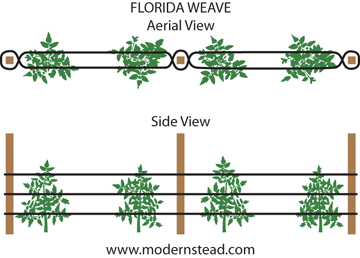
Next year I want to stake out our tomatoes the way I was taught for big rows: we’re constructing a Florida weave, or else.
This is efficient in terms of labor since no tomatoes are handled individually, orderly in appearance, and incredibly sturdy, since it relies on metal stakes pounded into the ground. It also works only in rows; this is the most pro-row you will ever see me.
Solution:
Next year I want to stake out our tomatoes the way I was taught for big rows: we’re constructing a Florida weave, or else.
This is efficient in terms of labor since no tomatoes are handled individually, orderly in appearance, and incredibly sturdy, since it relies on metal stakes pounded into the ground. It also works only in rows; this is the most pro-row you will ever see me.
Bushiness
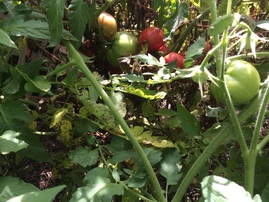 JUNGLE.
 One of the traditional ways of keeping any plant from putting its primary efforts into growing branches and to make it direct its energy toward producing fruit is pruning. When done to tomato plants, this is called ‘suckering’ – nipping the new baby branches that start to grow between leaves and main stems along the plant. We started strong with suckering, but the timing of our wedding in the middle of June meant that when we returned it felt like all our efforts had been for naught. Despite early, conscientious suckering, the tomato plants had each grown too many limbs for us to keep track of, each too big for us to prune without creating a large wound and possibility for infection. This probably contributed to the tomato jungle collapse effect.
Solution:
Don’t get married at the start of the growing season next year – or leave town for a week-and-a-half for any other reasons either, I guess?
Solution:
Don’t get married at the start of the growing season next year – or leave town for a week-and-a-half for any other reasons either, I guess?
I've been out to eat and that's for sure
But it's nothin' a homegrown tomato won't cure
For all our troubles with tomatoes, both good problems (abundance) and worse problems (tomato jungle), we did have a success that, to me, stands out above and beyond the rest. Behold our great technological innovation: self-delivering tomatoes! Not only did we not go out to eat ANY tomato dishes this summer, but sometimes we didn't have to even go outside the porch!
 RSS Feed