One of the most common instructions given to Victory Gardeners is succinctly illustrated below:
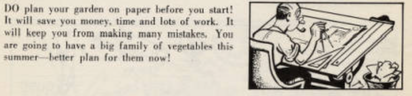
DO plan your garden on paper before you start!
Yup, a man (with pipe) sitting at an architect's desk. God knows a woman couldn't handle that goniometer? protractor? calipers? whatever he's holding. (I hope my inability to correctly identify his tool is not proving midcentury sexism correct.) Charging forward in the face of the first of many mistaken assumptions about my gender identity as a gardener, I agreed it would be prudent to make a plan. My first question?
SCALE
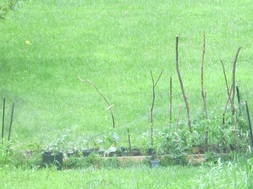 Dinky 48 sqft raised bed, late spring, 2015
 One fairly standard recommendation from the time ran, “There should be 1/10th of an acre for each member of the family on which 10 or more different kinds of vegetables are grown during the year.” An acre is 43,560 square feet. Ten percent of that would mean a garden of 66' by 66'. PER PERSON. The average population per household in 1940 was 3.67. That would mean a garden of 126' by 126' for the average American household; just under 16 thousand square feet.
For reference, the garden I tended last year was a raised bed of 4 ft by 12 ft. It took a fair amount of time, and occasionally I fell behind on harvesting the never-ending green beans and tomatoes. So you can imagine my emotions when I started wading through World War II pamphlets with example garden plans and found the likes of THIS MONSTROUS ONE-BOYSCOUT GARDEN:
For reference, the garden I tended last year was a raised bed of 4 ft by 12 ft. It took a fair amount of time, and occasionally I fell behind on harvesting the never-ending green beans and tomatoes. So you can imagine my emotions when I started wading through World War II pamphlets with example garden plans and found the likes of THIS MONSTROUS ONE-BOYSCOUT GARDEN:
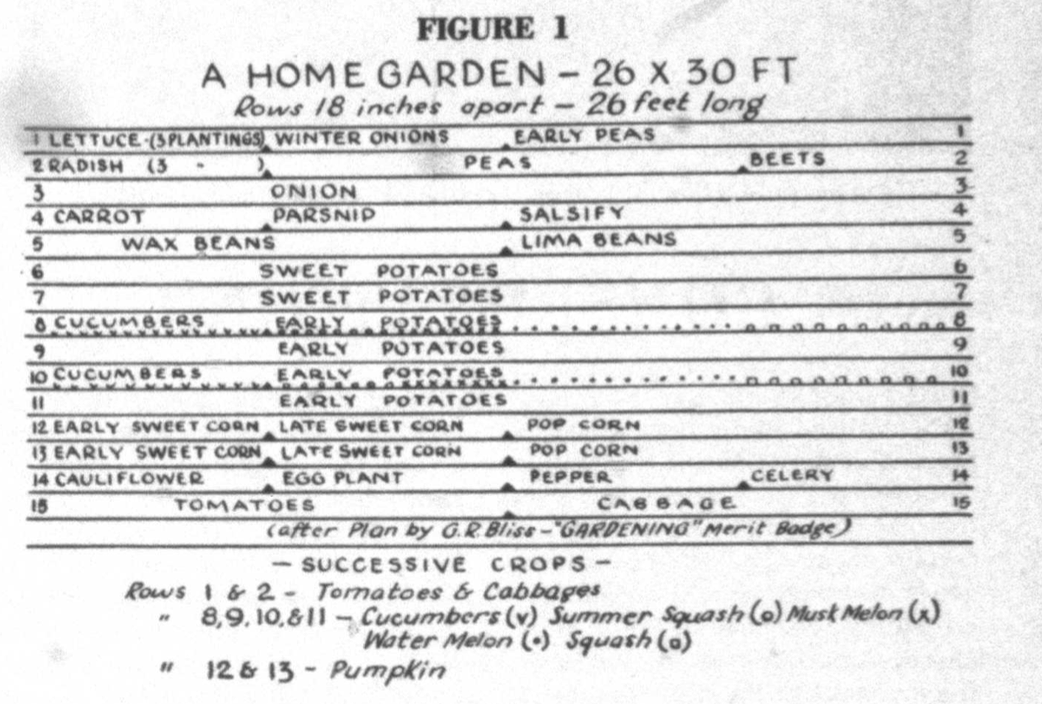
While humble compared to the 66'x66' ft per person recommendations, no Boy Scout I ...
I knew that, ambitious and determined as I was this summer, this was not the garden for me. Mounding the earth around growing potato plants is a lot of continuous physical labor, and six rows of 26' ft each would mean 156 linear feet of earth-mounding this summer. Something in me also doubts I could eat anything near that much sweet corn. (Although anyone who knows me, knows I could probably take care of that much popcorn, and then some ....) No, I would need a much humbler size garden to work with, one better in touch with the dietary preferences of this 21st century vegetarian academic.
Which brings me to my second question:
Which brings me to my second question:
Vegetable Variety
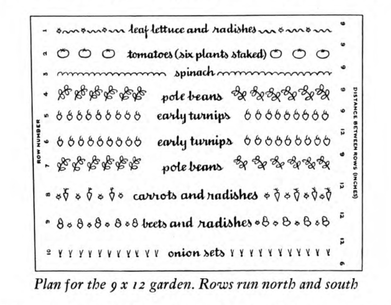
American diets have changed a lot since 1940. For starters, I suspect I eat a lot more kale than anyone in their right mind ate then, kale farmers excepted perhaps. There's a blog post coming in the future about levels of fresh produce and vegetable consumption rising and falling over the twentieth century, but for now, let's operate on the easy assumption that the vegetable landscape was pretty different. This became more and more apparent as I contemplated actually eating from these gardens, scrolling through the collection of sample Victory Garden designs I've accumulated.
Take, for example, the plan here. The scale is much more my size -- if anything, verging on too small and too unambitious! (Full disclosure: this 9' x 12' garden plan is meant for city growers with only that much land in their backyards; I do not have this space constraint, and thus would feel doubly guilty scaling down.) Size aside, if I were only planting a mere ten rows of vegetables, there is no way that three of those rows would include radishes (a total of 36'!!!) or that two of them would be devoted to turnips, much as I love a hearty root stew. So this plan was clearly out of the running.
However, there was a third consideration at play...
Take, for example, the plan here. The scale is much more my size -- if anything, verging on too small and too unambitious! (Full disclosure: this 9' x 12' garden plan is meant for city growers with only that much land in their backyards; I do not have this space constraint, and thus would feel doubly guilty scaling down.) Size aside, if I were only planting a mere ten rows of vegetables, there is no way that three of those rows would include radishes (a total of 36'!!!) or that two of them would be devoted to turnips, much as I love a hearty root stew. So this plan was clearly out of the running.
However, there was a third consideration at play...
Representative-ness (for lack of a better term...)
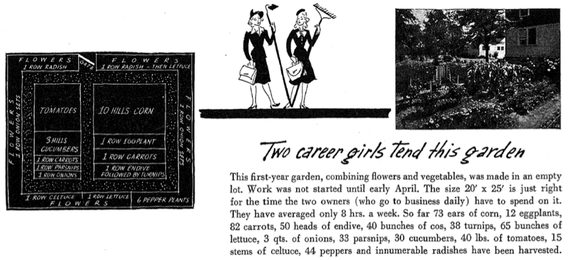
The plan I chose had to be as close to typical as I could find, based on my extensive reading in World War II Victory Garden sources. Why bother with this experiment at all if I were going to plant and grow an outlier design that bore little relationship to anything else I saw and read from the period? A great example of this is the above plan from a House and Garden article on Victory Gardening in 1944. While I absolutely love the idea of following in the footsteps of working girls like me almost three-quarters of a century ago (yes, I consider graduate school work), I have seen nothing else like this plan: the thick border of mixed flowers and vegetables, the shockingly sensible placement of footpaths, the surprising prominence of endives. While it was a garden that two real Americans apparently grew in World War II, it doesn't appear to be the average garden -- or at least not the average garden recommended and depicted in media of the time.
THE (NEARLY) PERFECT SMALL GARDEN PLAN:
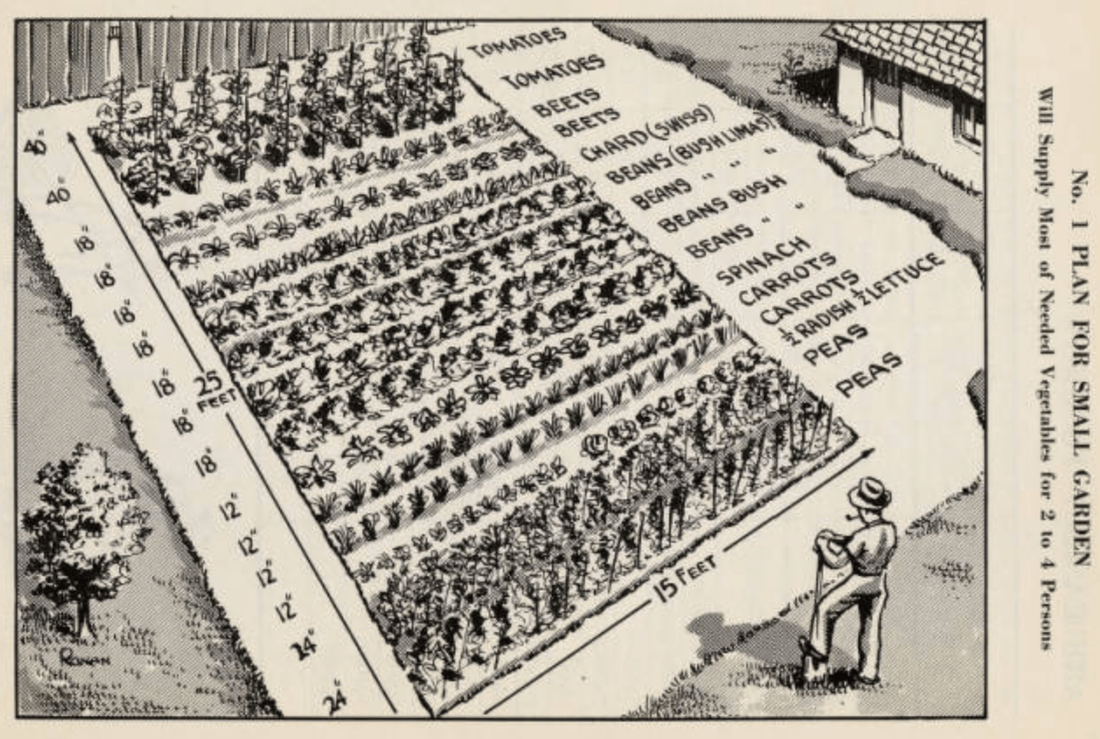
This is ultimately the garden plan I decided on (in consultation with my partner, I.E. the other half of my workforce). It comes from a great pamphlet aimed at beginners: ABC of Victory Gardens. The fifteen foot length of the rows seemed ideal, and the variety of vegetables largely appealing. However, we did want to shrink it down just a little, so we eliminated duplicate rows of less-exciting vegetables to end up with our final plan. We cut:
For now, back to nursing my starts and seedlings so they are ready to form rows out in the sun of my 15' x 18.5' planned patch of Victory....
- One row of beets (because how much borscht can two people eat?),
- One row of each type of bean (they produce so much!)
- One row of carrots (in part because of my fear of failure with root plants - I can never see what they are doing!)
- And one row of peas (just for manageability, really)
For now, back to nursing my starts and seedlings so they are ready to form rows out in the sun of my 15' x 18.5' planned patch of Victory....
 RSS Feed